Lecture 2: Hypothyroidism — What Patients Need to Know
Hypothyroidism is the most common thyroid disorder in the United States. Millions of people are living with it — many of them without knowing it, and many others who have been diagnosed but still do not feel well. Understanding what hypothyroidism actually is, what it does to your body and your mind, and what treatment can and cannot accomplish is the foundation of living well with this condition.
What Is Hypothyroidism?
Hypothyroidism means your thyroid gland is not producing enough thyroid hormone. The thyroid — a butterfly-shaped gland at the base of your neck — produces two hormones: T4 (thyroxine) and T3 (triiodothyronine). These hormones regulate virtually every metabolic process in your body: your heart rate, your body temperature, your energy production, your mood, your digestion, your weight, and your cognitive function.
When thyroid hormone levels fall too low, everything slows down. That is the essence of hypothyroidism.
What Causes It?
The most common cause in the United States is Hashimoto's thyroiditis — an autoimmune condition in which the immune system attacks the thyroid gland over time, gradually destroying its ability to produce hormone. Other causes include:
- Prior thyroid surgery (removal of part or all of the thyroid)
- Radioactive iodine treatment for hyperthyroidism or thyroid cancer
- Radiation therapy to the neck
- Certain medications (lithium, amiodarone, some immunotherapy drugs)
- Iodine deficiency (rare in the US)
- Congenital hypothyroidism (present from birth)
In many cases, hypothyroidism develops slowly over years, and patients may not recognize the symptoms until they become significant.
The Physical Symptoms
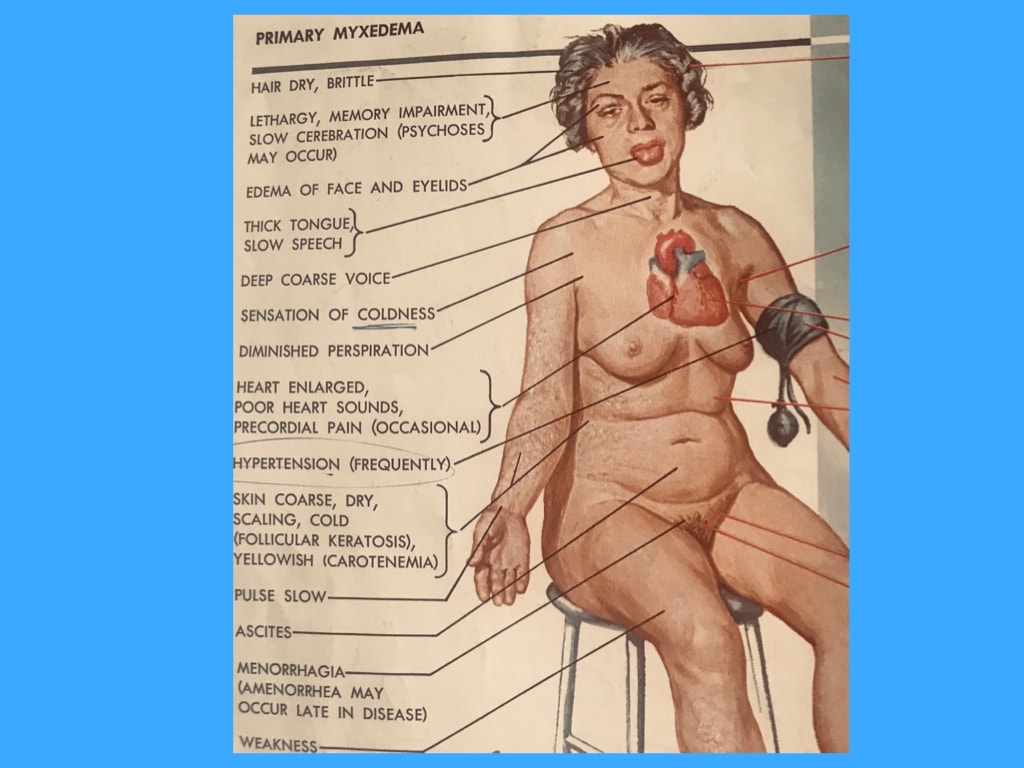
Hypothyroidism produces a wide range of physical symptoms, many of which are easy to attribute to other causes — aging, stress, poor sleep, or simply "getting older."
Common physical symptoms include:
- Fatigue and low energy, even after adequate sleep
- Weight gain or difficulty losing weight despite normal eating
- Cold intolerance — feeling cold when others are comfortable
- Dry skin, brittle nails, and hair loss or thinning
- Constipation
- Slowed heart rate (bradycardia)
- Muscle weakness, aches, and cramps
- Puffiness in the face, especially around the eyes
- Hoarseness
- Elevated cholesterol levels
- In women: irregular or heavy menstrual periods
The severity of symptoms varies widely. Some patients with significantly low thyroid hormone levels feel relatively well; others with borderline levels feel profoundly unwell. The numbers do not always predict the experience.
The Emotional and Psychological Impact
This is the dimension of hypothyroidism that medicine has historically underaddressed — and it is the one that most affects quality of life.
Depression is one of the most common symptoms of hypothyroidism, and it is frequently misdiagnosed as primary psychiatric illness. Patients are prescribed antidepressants when what they need is thyroid hormone. The relationship between thyroid function and mood is direct and biochemical: thyroid hormone is required for the production and regulation of serotonin, dopamine, and other neurotransmitters.
Cognitive symptoms — brain fog, difficulty concentrating, memory problems, slowed thinking — are real and disabling. Patients describe feeling as though they are "thinking through cotton." These symptoms are often dismissed by physicians who see normal-range TSH values and conclude the patient is fine.
Anxiety can coexist with hypothyroidism, particularly in Hashimoto's patients, where fluctuating hormone levels can produce periods of both under- and over-activity.
The emotional weight of a chronic diagnosis — knowing that this is a lifetime condition requiring lifetime management — is itself a source of grief and adjustment. Many patients go through a period of mourning for the health they had before, and for the simplicity of a life without daily medication and regular blood tests.
Diagnosis: The TSH Test and Its Limitations
Hypothyroidism is diagnosed primarily through a blood test measuring TSH (thyroid-stimulating hormone). TSH is produced by the pituitary gland; when thyroid hormone levels are low, the pituitary produces more TSH to stimulate the thyroid to produce more hormone. An elevated TSH therefore indicates hypothyroidism.
The standard reference range for TSH is approximately 0.4–4.0 mIU/L, though this varies by laboratory. Subclinical hypothyroidism — a mildly elevated TSH with normal T4 levels — is a common and often debated finding.
Important limitations of TSH testing:
- TSH reflects pituitary function, not necessarily how much active thyroid hormone is reaching your cells
- Many patients feel unwell at TSH levels that fall within the "normal" range
- Free T4 and Free T3 levels provide additional information that TSH alone does not capture
- Thyroid antibody testing (anti-TPO, anti-thyroglobulin) can identify Hashimoto's thyroiditis even before TSH becomes abnormal
If you do not feel well and your TSH is "normal," that does not mean nothing is wrong. A thorough evaluation includes Free T4, Free T3, and antibody levels.
Treatment: Levothyroxine and Its Alternatives
The standard treatment for hypothyroidism is levothyroxine (brand names: Synthroid, Levoxyl, Tirosint) — a synthetic form of T4. It is the most prescribed medication in the United States.
For many patients, levothyroxine works well. TSH normalizes, symptoms resolve, and quality of life returns to baseline.
For others, it does not. These patients continue to experience fatigue, brain fog, depression, and weight problems despite a "normal" TSH on levothyroxine. The reason is that levothyroxine provides only T4, which must be converted to the active form T3 in peripheral tissues. Some patients — particularly those with certain genetic variations in the deiodinase enzymes responsible for this conversion — do not convert T4 to T3 efficiently.
Alternatives and additions include:
- Liothyronine (Cytomel): Synthetic T3, sometimes added to levothyroxine for patients who remain symptomatic.
- Combination T4/T3 therapy: Some endocrinologists prescribe both levothyroxine and liothyronine together for patients who do not convert T4 to T3 efficiently.
The choice of treatment should be individualized. If you are not feeling well on your current regimen, that is a conversation worth having with your physician — and worth pursuing until you get an answer.
Living with Hypothyroidism: What Lifetime Management Means
Hypothyroidism is, for most patients, a permanent condition. The thyroid does not regenerate. Once destroyed by Hashimoto's, surgery, or radioactive iodine, its function does not return.
This means:
- Daily medication for the rest of your life
- Regular TSH monitoring — typically every 6–12 months once stable, more frequently when doses are being adjusted
- Dose adjustments over time, as the body's needs change with age, weight changes, pregnancy, and other factors
- Awareness of interactions — many medications and supplements affect thyroid hormone absorption and metabolism
This is not a small thing to absorb. The adjustment to a lifetime diagnosis takes time, and the emotional work of that adjustment is real and valid.
What You Can Do Right Now
- If you have symptoms of hypothyroidism and have not been tested, ask your doctor for a TSH, Free T4, Free T3, and thyroid antibody panel.
- If you have been diagnosed and are not feeling well on treatment, ask about Free T3 levels and whether your current regimen is optimal for you.
- If you are newly diagnosed, give yourself time to adjust — both physically and emotionally. The medication takes 4–6 weeks to reach full effect, and finding the right dose can take months.
- Reach out for support. You are not the only person navigating this.
Dr. Guttler spent 50 years as a private thyroid medical specialist. He does not treat patients. The information on this site is for educational purposes and does not constitute medical advice. Always consult your physician for diagnosis and treatment.
Explore Topics
Written by
Dr. Guttler
Clinical Thyroidologist with over 50 years of experience treating patients with thyroid cancer, nodules, hypothyroidism, and hyperthyroidism. Dr. Guttler created these patient education lectures to help people understand their thyroid condition and make informed decisions about their care.