Ethanol Ablation for Thyroid Cysts: A Proven, Non-Surgical Option
A 2020 review in Ultrasonography confirms that ethanol ablation is a safe, effective, and minimally invasive treatment for benign thyroid cysts — with high success rates and far fewer risks than surgery. Dr. Guttler explains what patients need to know.
The Article
Kim JH, Baek JH, Lim HK, et al. "2019 Consensus Statement for the Management of Thyroid Nodules." Ultrasonography. 2020 Dec 28; 40(3):417–427.
This consensus statement, published in Ultrasonography in late 2020, addresses the management of thyroid nodules — including the role of ethanol ablation (also called percutaneous ethanol injection, or PEI) for benign cystic thyroid nodules. It reflects the accumulated evidence from decades of clinical experience and multiple randomized trials, and it confirms what specialists in this field have known for years: ethanol ablation works, it is safe, and for the right patient it is far preferable to surgery.
What Is a Thyroid Cyst?
A thyroid cyst is a fluid-filled sac within the thyroid gland. Most thyroid nodules contain at least some fluid, but purely cystic nodules — those that are predominantly or entirely fluid — are a distinct category. They are almost always benign. The concern with thyroid cysts is not cancer; it is size and symptoms.
A large thyroid cyst can cause:
- A visible lump or swelling in the neck
- Pressure or tightness in the throat
- Difficulty swallowing
- A sensation of something stuck in the throat
- Cosmetic concern
The traditional treatment for a symptomatic thyroid cyst has been surgery — either a partial or total thyroidectomy. Surgery works, but it carries real risks: general anesthesia, scarring, potential damage to the parathyroid glands or recurrent laryngeal nerve, and lifelong thyroid hormone replacement if enough thyroid tissue is removed.
For a benign cyst, that is a significant price to pay.
What Is Ethanol Ablation?
Ethanol ablation — percutaneous ethanol injection (PEI) — is a minimally invasive procedure in which a small amount of pure ethanol (medical-grade alcohol) is injected directly into a thyroid cyst under ultrasound guidance. The ethanol causes the cyst wall to scar down and the fluid to be permanently reabsorbed. The cyst shrinks — often dramatically — without surgery.
The procedure is performed in an outpatient setting. A thin needle is inserted through the skin of the neck under real-time ultrasound visualization. The cyst fluid is first aspirated (drained), and then a carefully measured volume of ethanol is injected into the cyst cavity. The ethanol is left in place for a few minutes and then re-aspirated. The entire procedure typically takes less than 30 minutes.
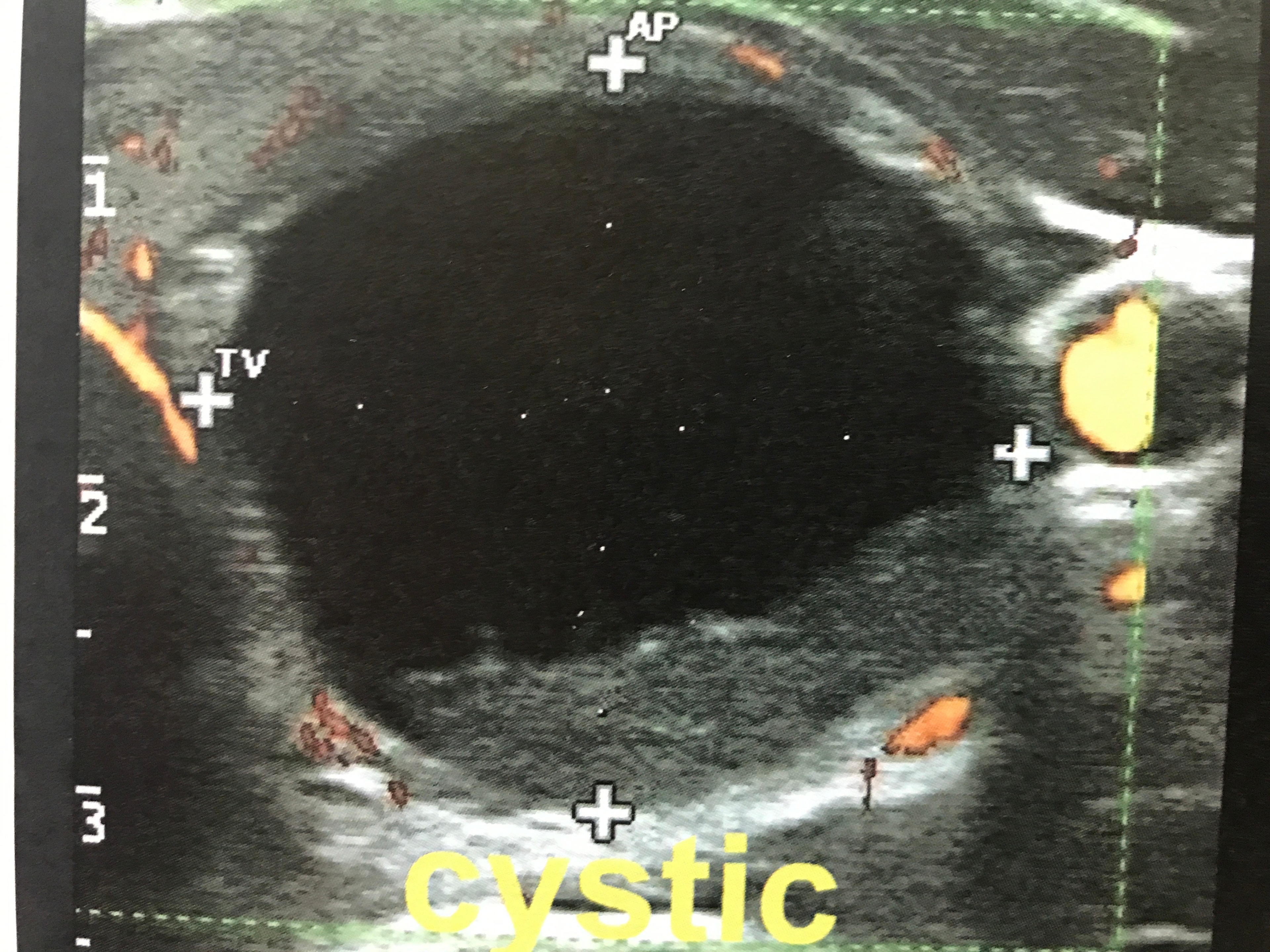
The ultrasound image above shows a large cystic thyroid nodule — the kind of lesion that is an ideal candidate for ethanol ablation. The dark, anechoic (fluid-filled) center is the cyst. The color Doppler signals around the periphery show blood flow in the surrounding thyroid tissue. This is exactly the type of image a thyroid specialist reviews before recommending PEI.
What the Evidence Shows
The evidence for ethanol ablation in benign thyroid cysts is strong and consistent across multiple studies and now reflected in formal consensus guidelines.
High Success Rates
For purely cystic nodules, ethanol ablation achieves significant volume reduction — typically 80 to 90 percent shrinkage — in the majority of patients. Many patients require only a single treatment session. Recurrence rates are low, particularly for purely cystic lesions.
For mixed cystic-solid nodules (part fluid, part solid tissue), results are somewhat less dramatic but still clinically meaningful. In these cases, ethanol ablation may be combined with radiofrequency ablation (RFA) of the solid component for optimal results.
Safety Profile
The safety record of ethanol ablation for thyroid cysts is excellent. The most common side effects are transient: local pain or burning at the injection site during the procedure, which resolves quickly. Serious complications — nerve injury, infection, significant bleeding — are rare when the procedure is performed by an experienced operator under ultrasound guidance.
There is no general anesthesia. There is no surgical incision. There is no scar. Patients typically return to normal activity the same day.
Comparison to Surgery
The consensus statement and the broader literature are clear: for benign thyroid cysts, ethanol ablation achieves comparable symptom relief to surgery with a fraction of the risk and recovery time. Surgery remains appropriate for certain situations — very large nodules with significant solid components, nodules with suspicious features, or cases where ablation has failed — but for the typical benign cystic nodule, PEI should be considered before surgery is recommended.
My Experience With Ethanol Ablation
I have been performing ethanol ablation for thyroid cysts for many years — long before it became widely recognized in American thyroid guidelines. I trained with Dr. Jack Baskin, one of the early American pioneers of this technique, and I have seen firsthand what it can do for patients who would otherwise face surgery.
The procedure is straightforward in experienced hands. The key is proper patient selection — confirming that the nodule is truly benign (which requires a fine needle aspiration biopsy if there are any suspicious features), accurately characterizing the cystic versus solid components on ultrasound, and using the right volume of ethanol for the size of the cyst.
When those conditions are met, the results are consistently good. Patients come in with a symptomatic neck lump and leave the same day with the cyst drained and the ablation complete. Over the following weeks and months, the cyst shrinks and the symptoms resolve. Most patients never need another procedure.
Training With the Masters
My path to becoming an RFA physician was built on the shoulders of two extraordinary teacher-researchers — one in Korea, one in Italy.
In 2017, I traveled to Reggio Emilia, Italy to spend a week training with Dr. Roberto Valcavi — the world's foremost master of radiofrequency ablation for thyroid nodules. Dr. Valcavi pioneered RFA in Europe and his center became the global training ground for physicians who wanted to learn the technique at the highest level. That week in Italy was transformative. I returned home with the hands-on skills and the clinical confidence to bring RFA to my patients in Santa Monica.
A Personal Note: Dr. Jung Hwan Baek
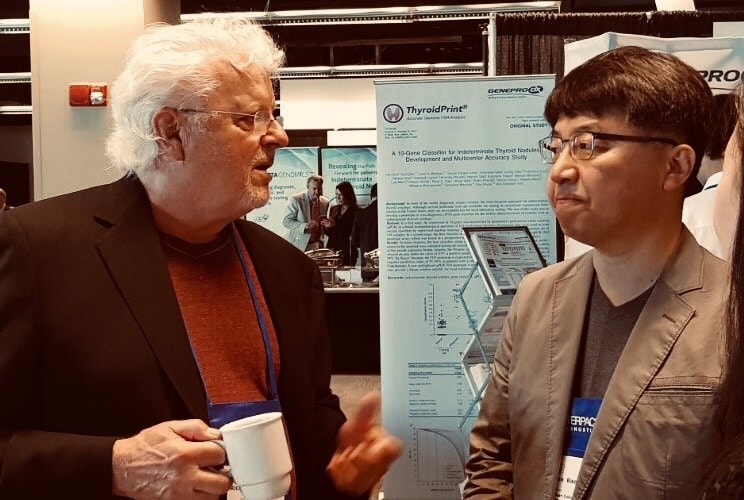
Dr. Jung Hwan Baek (right) and Dr. Richard Guttler at a thyroid conference. Dr. Baek is one of the world's foremost authorities on ethanol ablation and radiofrequency ablation of thyroid nodules.
I want to say something personal about the man whose research underpins much of what we know about thyroid ablation today.
Dr. Jung Hwan Baek of Asan Medical Center in Seoul, South Korea, is one of the great teacher-researchers in this field. His work on both ethanol ablation and radiofrequency ablation has set the standard for how these procedures are performed worldwide. The consensus guidelines we follow today — including the 2020 Ultrasonography statement — reflect decades of his meticulous clinical research.
I had the privilege of working with Dr. Baek directly, and I credit that collaboration as a key part of how I was able to help jump-start RFA in the United States. Along with two RFA companies who helped promote the technology in America, Dr. Baek's mentorship gave me the foundation to bring this technique to my patients. I had RFA machines in my office to practice and teach — and eventually, when the procedure received proper recognition, to treat patients who would otherwise have faced surgery.
It is one thing to read the literature. It is another to learn from the person who wrote it. I am grateful for that opportunity, and I believe my patients have benefited directly from it.
What Patients Should Know
Not every thyroid nodule is a candidate for ethanol ablation. PEI works best for nodules that are predominantly or entirely cystic. Solid nodules do not respond to ethanol; they require radiofrequency ablation (RFA) or surgery.
Biopsy first. Before any ablation procedure, a fine needle aspiration (FNA) biopsy should confirm that the nodule is benign. Ethanol ablation is not appropriate for nodules with suspicious or malignant cytology.
Ultrasound guidance is essential. This procedure must be performed under real-time ultrasound visualization by an operator experienced in thyroid intervention. It is not a procedure to have done by someone who performs it occasionally.
Results take time. The cyst does not disappear immediately after the procedure. Shrinkage occurs gradually over weeks to months as the body reabsorbs the treated tissue. Follow-up ultrasound at three to six months confirms the response.
It may need to be repeated. A minority of patients — particularly those with mixed cystic-solid nodules or very large cysts — require a second treatment session. This is still far less invasive than surgery.
Ask about your options. If you have a symptomatic thyroid cyst and your doctor has recommended surgery, it is entirely reasonable to ask: "Am I a candidate for ethanol ablation?" If your doctor is not familiar with the procedure, ask for a referral to a thyroid specialist who performs it.
The Bottom Line
Ethanol ablation is a proven, safe, and effective treatment for benign thyroid cysts. The 2020 consensus statement in Ultrasonography reflects decades of evidence and the experience of leading thyroid centers worldwide. For the right patient, it eliminates the need for surgery entirely.
If you have a thyroid cyst that is causing symptoms — pressure, swelling, difficulty swallowing — you deserve to know that a non-surgical option exists. Ask your doctor whether ethanol ablation is right for you.
Reference: Kim JH, Baek JH, Lim HK, et al. "2019 Consensus Statement for the Management of Thyroid Nodules." Ultrasonography. 2020 Dec 28; 40(3):417–427.
Dr. Richard Guttler is a thyroid specialist with over 50 years of clinical experience in Santa Monica, California. This article is for educational purposes only and is not personal medical advice.
Explore Topics
Written by
Dr. Richard Guttler
Clinical Thyroidologist with over 50 years of experience treating patients with thyroid cancer, nodules, hypothyroidism, and hyperthyroidism. Dr. Guttler created these patient education lectures to help people understand their thyroid condition and make informed decisions about their care.